The Element of Art Is Created When Pure Light Goes Through a Prism
- Abode
- The Scientific discipline of Color
- Making Color
- Matching Color
- Using colour
- Events and Info
The Science of Color
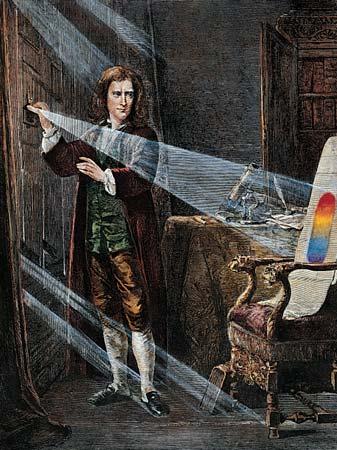 |
| Sir Isaac Newton experimenting with a prism. Engraving after a moving picture by J.A. Houston, ca. 1870. Courtesy of The Granger Collection, New York |
In the 1660s, English language physicist and mathematician Isaac Newton began a serial of experiments with sunlight and prisms. He demonstrated that clear white light was equanimous of vii visible colors.
By scientifically establishing our visible spectrum (the colors we see in a rainbow), Newton laid the path for others to experiment with color in a scientific manner. His work led to breakthroughs in optics, physics, chemical science, perception, and the study of color in nature.
Aristotle adult the first known theory of color believing it was sent by God from heaven through celestial rays of light. He suggested that all colors came from white and black (lightness and darkness) and related them to the four elements – h2o, air, world, and burn. Aristotle's behavior on color were widely held for over 2000 years until being replaced past those of Newton.
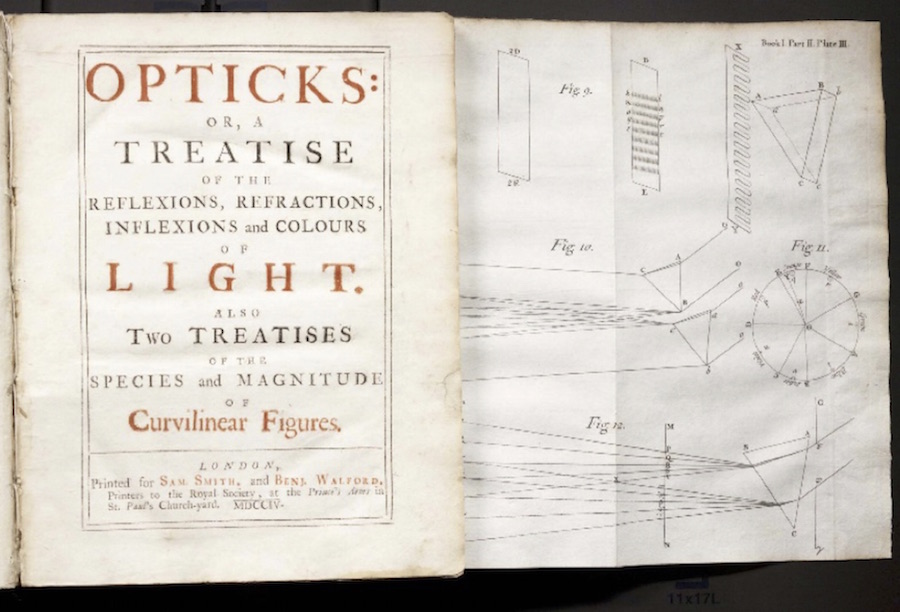 |
| Sir Isaac Newton |
Opticks, 1 of the dandy works in the history of scientific discipline, documents Newton'south discoveries from his experiments passing light through a prism. He identified the ROYGBIV colors (blood-red, orangish, xanthous, greenish, blue, indigo, and violet) that brand upwards the visible spectrum. The visible spectrum is the narrow portion within the electromagnetic spectrum that can be seen by the human eye. Other forms of electromagnetic radiation, waves of energy, that we cannot see include radio, gamma and microwaves. The cells in our eyes called cones are sensitive to the wavelengths found in the visible spectrum. They allow us to see the all the colors of the rainbow.
…if the Sun'southward Lite consisted of simply one sort of Rays, there would be but one Colour in the whole World…
–Sir Isaac Newton, Opticks
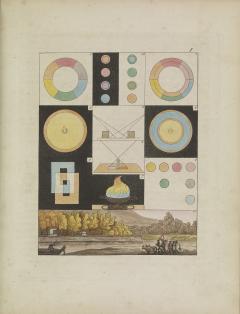 |  |  |
| Johann Wolfgang von Goethe | ||
Goethe challenged Newton's views on color, arguing that color was non but a scientific measurement, but a subjective experience perceived differently by each viewer. His contribution was the first systematic report on the physiological effects of colour. Goethe's views were widely adopted past artists. Although Goethe is all-time known for his poetry and prose, he considered Theory of Colors his most important work.
Colour are low-cal'south suffering and joy.
–Johann Wolfgang von Goethe
This very rare book formed the foundation for modern color printing. Le Blon was the first to outline a 3-color press method using principal colors (carmine, yellow, blue) to create secondary colors (green, purple, orange). He makes an important distinction between "textile colors," as used by painters, and colored light, which was the focus of Newton's color theories. Le Blon'southward distinction marks the start documentation of what is at present referred to as additive and subtractive color systems. Rainbows, TVs, estimator screens and mobile devices all emit light and are examples of an condiment colour organization (the subject of Newton's Opticks). Ruddy, green and blueish are the primary additive colors and when combined they produce transparent white low-cal. Books, paintings, grass and cars are examples of a subtractive colour system which is based on the chemical makeup of an object and its reflection of low-cal every bit a color. Subtractive primary colors - blueish, red, and yellow – are frequently taught to us as children, and when mixed together they create black.
…I arriv'd at the skill of reducing the Harmony of Colouring in painting to Mechanical Do…
–J.C. Le Blon, Coloritto
These colorful line diagrams reveal the chemic compositions of metals. When a pure metal is burned and viewed through a spectroscope, each chemical element gives off unique spectra, a sort of color fingerprint. This method, called spectral analysis, led to the discovery of new elements, and marked the commencement steps towards quantum theory.
Tin can you see the numbers in the circles? 4.5 percent of the population cannot encounter the entire visible spectrum, a condition chosen colour vision deficiency, or colour blindness. Ishihara plates are used to test patients for the various types of colour blindness.
Can yous find the animal hiding in this prototype? Camouflage uses color to conceal forms by creating optical illusions. American artist Abbott Thayer introduced the concept ofconfusing patterning, in which an animal's uneven markings can disguise its outline. In this illustration Thayer shows how a peacock can disappear into its surroundings.
Thayer, an American artist, devoted much of his life to understanding how animals conceal themselves in nature for survival. In his book, Concealing Coloration in the Beast Kingdom, Thayer presented his behavior of protective coloration every bit an essential factor in development helping animals disguise themselves from predators. He received much praise and criticism. He was extreme in his views arguing that all animal coloration was for protective purposes and failing to recognize other possible reasons such as sexual selection – characteristics for attracting a mate. Teddy Roosevelt nearly notably attacked his theories by pointing out that this darkening doesn't last all season, or even all twenty-four hour period, merely was dependent on a single frozen moment in times. Despite these shortcomings, Thayer went on to be the first to advise camouflage for military purposes. Although his suggestions were initially rejected, his onetime students were among the founders of the American Camouflage Gild in 1916 and his theories were somewhen adopted and are withal used today.
 |
| Albatross D.Va, 1917-1918 Courtesy of the National Air and Space Museum |
The colorful pattern on this German aircraft from World War I is called lozenge camouflage. Its disruptive pattern applied Abbott Thayer'south theories in an effort to inhibit enemy observation from the air and on the ground.
turnerhatilight39.blogspot.com
Source: https://library.si.edu/exhibition/color-in-a-new-light/science
0 Response to "The Element of Art Is Created When Pure Light Goes Through a Prism"
Post a Comment